The receipt test: what survives when software goes headless
@kawishwaqar|October 19, 2026 (1d ago)5 views
Disclosure: I work at Jazz as Principal Evangelist Cloud & AI. This article is written as personal industry analysis. Views are my own.
3am, Karachi
At 3am the Mac mini on my shelf in Karachi wakes a job. It pulls the overnight advisories and filings for my security and legal digest, reads them, checks each one against what it flagged the day before, and posts a summary to a channel I will open over breakfast. Another job writes my market brief. A third watches compute prices. Nobody watched a screen do any of it. There was no screen to watch.
That is the whole shift in one image.
What headless actually means
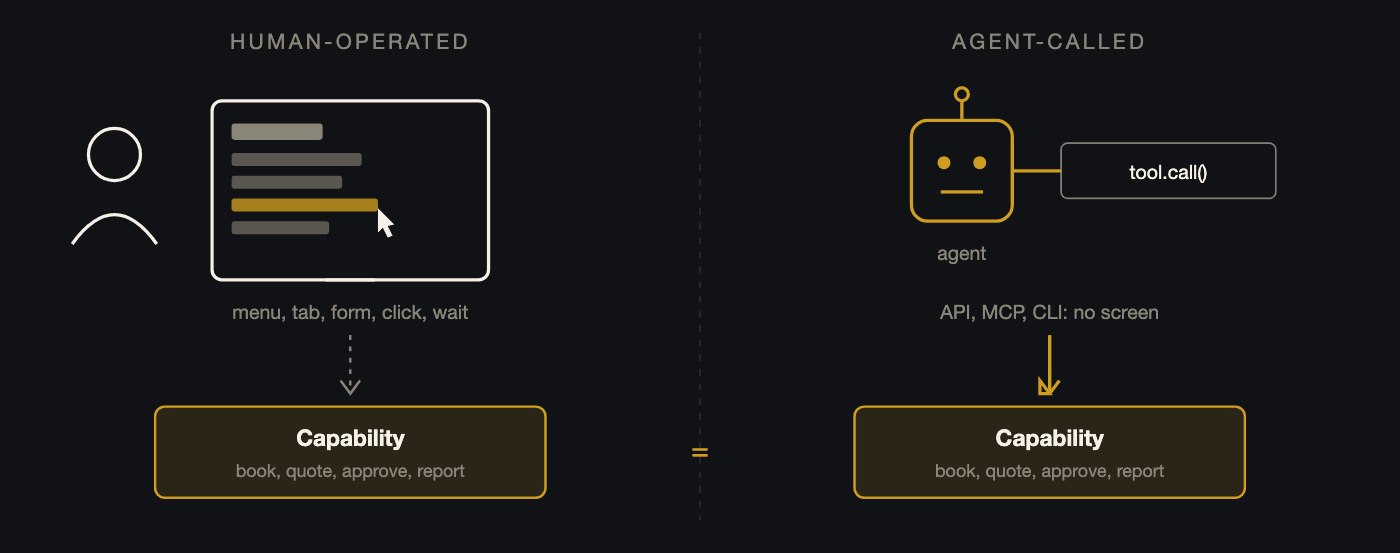
Here is the definition I work with. The API is the primary interface. The GUI is a layer on top of it, one client among several. Natural language is a real channel. And the API surface is consistent enough that a machine can call it without a human translating between screens.
In 2026 the dividing line is simple: agent-callable or not. Salesforce made that explicit with Headless 360, launched on 15 April 2026 and expanded in August, on the premise that agents should use Salesforce capabilities without opening a browser. It ships 60+ MCP tools, a CLI, and integration into ChatGPT and Claude Code. Salesforce's own framing is that the "inner face" (GUI, dashboards, intelligence layer) is table stakes and the "outer face" (multi-modal, agentic) is the battleground. Reuters attributes a blunter line to Marc Benioff: "it is the end of the SaaS era as we know it."
InfoWorld put the test plainly: "If your platform requires humans to click through UIs, it is not ready for the agentic enterprise." The shift moves fastest in payments, marketing, scheduling, analytics and content, and slower in collaboration, design and legal.
The plumbing exists. The official Model Context Protocol registry held about 9,652 server records in a May 2026 pull. Anthropic cites 10,000+ active public servers and roughly 97 million monthly SDK downloads; another survey counts 17,000+ publicly listed servers.
Where the human stays
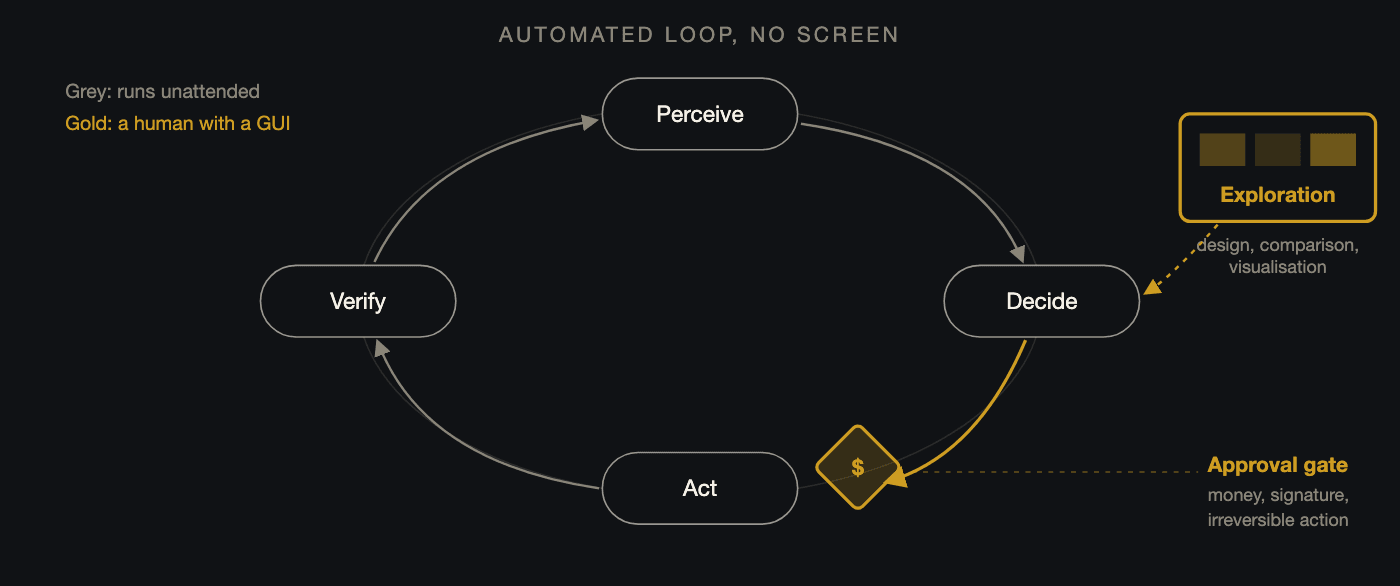
Headless does not mean no human. GUIs are not vanishing. They are retreating to two places where a person's judgement is the actual work.
The first is the decision interface: approving a budget, signing a contract, confirming anything you cannot undo. The second is the exploration interface: design, comparison, visualisation. Everything between (perceive, decide, act, verify) can run as a loop with no screen.
Nobody sane removes the approval step from a purchase. My agents read, draft and flag all night, but none of them can spend a rupee without me tapping yes. That is not a limitation I plan to engineer away. It is the product: a headless app with a human at the money gate.
The supply side landed in one window
On 31 May 2026 at Computex, NVIDIA announced RTX Spark, a 1 PFLOPS (FP4) superchip: a 20-core Grace CPU co-designed with MediaTek, a Blackwell RTX GPU with 6,144 CUDA cores, up to 128GB of LPDDR5X unified memory, about 300 GB/s of bandwidth, and NVLink-C2C. NVIDIA claims it runs a 120B model with a 1M-token context locally, in laptops about 14mm thick and roughly 3 lbs. On 2 June at Build, Microsoft announced Scout, its first always-on personal agent for Microsoft 365, with Aion 1.0 Instruct (a small on-device model) and Aion 1.0 Plan, a 14B reasoning and tool-calling model with a 32K context that runs fully agentic workflows on the device with no cloud call. In the same window Nous Research shipped Hermes Desktop.
Then at IFA in Berlin, NVIDIA released PAIR, a free open-source Personal AI Router that presents a home network's machines to Ollama and LM Studio as a single endpoint. It deliberately does not pool memory; it schedules whole requests across idle machines. NVIDIA product manager Seth Schneider described a household with a DGX Spark, an RTX 5090 laptop, a gaming tower and a MacBook Pro as roughly 165 teraflops of idle compute, "a treasure trove of free tokens just sitting in homes today." In one unofficial demo, a five-subagent task on Qwen 3.6 35B went from 18 minutes on one RTX Spark laptop to 8 minutes 48 seconds across three machines.
Stanford's Hazy Research group summed it up in its May 2026 retrospective: "the future of inference is hybrid by design, local by default." Their Minions work recovered 97.9% of GPT-4o accuracy at 5.7x lower cost, Intelligence per Watt improved 5.3x in two years, and 88.7% of single-turn chat and reasoning queries are answerable locally. IDC and Canalys put roughly half of all PCs shipped in 2026 as AI PCs with an NPU.
The cost inversion
Cloud inference is metered opex: every step, every page read, every retry shows up on a bill. A local box is fixed capital, and once you own it the marginal run costs little more than electricity.
That flips the incentive. Metered, you want the agent to do less. Owned, you want it running all night. Satya Nadella put it in vendor language, and I quote it as vendor framing, not a finding:
"RTX Spark marks a real breakthrough towards delivering unmetered intelligence to every home and desk with Windows."
Satya Nadella, Microsoft (vendor framing)
The arXiv paper "Personal AI, On Personal Devices" is less glossy: today's personal AI stacks "demand thousands of dollars per year in recurring API and subscription spend." At Computex, Perplexity's CEO claimed (a vendor claim) that revenue grew roughly fivefold, from about $100M to $500M, with only a 34% increase in team size, and that offloading inference to user hardware helps preserve that ratio.
I would not overread it. The Stanford retrospective also notes that personal-AI runtimes still route nearly everything to cloud APIs today. The inversion is available; most people have not taken it.
What a 24-hour agent actually costs
Here is the arithmetic, at pricing in use as I write, so you can check it.
Agent tasks burn 10 to 100 times the tokens of a chat turn, and in real sessions input to output ratios run from 20:1 to 100:1, so input and cache pricing dominate the bill. Artificial Analysis shows the spread: roughly 3 cents per test for the cheap tier against $1.86 for GPT-5.6 Sol and $3.15 for Claude Fable 5.
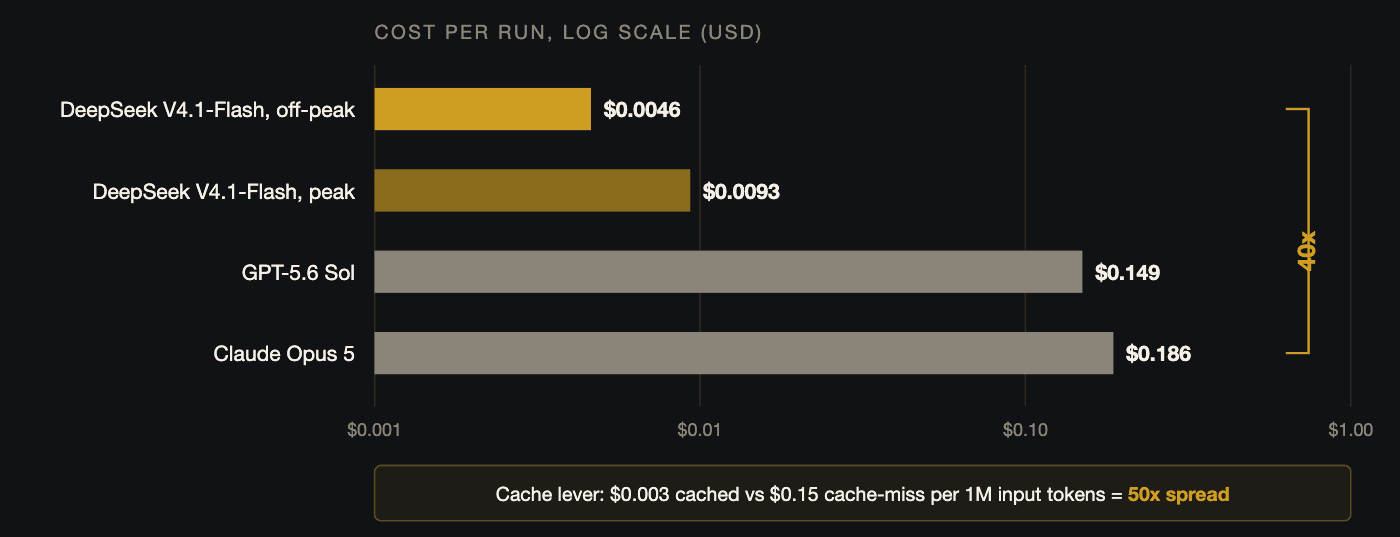
My model workload is 40 background runs a day, each with 60,000 input tokens and 3,000 output tokens, 70% of input served from cache: 1,200 runs a month. On DeepSeek V4.1-Flash off-peak pricing ($0.003 per million cached input, $0.15 per million cache-miss input, $0.60 per million output; peak hours are double), one run works out like this:
cached input   42,000 × $0.003 / 1M = $0.000126
fresh input   18,000 × $0.15  / 1M = $0.002700
output        3,000 × $0.60  / 1M = $0.001800
per run                            ≈ $0.0046
per month   $0.004626 × 1,200 runs      = $5.55
Same workload, four tiers: 40 runs a day, 60,000 input and 3,000 output tokens per run, 70% cache hits, 1,200 runs a month.
| Tier | Pricing basis | Per run | Per month | vs cheapest | |---|---|---|---|---| | DeepSeek V4.1-Flash, off-peak | $0.003 cached, $0.15 miss, $0.60 output per 1M | $0.0046 | $5.55 | 1x | | DeepSeek V4.1-Flash, peak | Off-peak rates doubled | $0.0093 | $11.10 | 2x | | GPT-5.6 Sol | Cached input pricing | $0.149 | $178.56 | 32x | | Claude Opus 5 | Cached input pricing | $0.186 | $223.20 | 40x |
The frontier tier costs 40x the cheap tier for the same loop. The cache is the other lever: $0.003 against $0.15 per million input tokens is a 50x spread.
This is arithmetic, not a recommendation to run everything cheap. The high-frequency loop goes cheap; the hard 10% escalates to a frontier model.
The counterweight, plainly: DeepSeek raised V4 prices as demand strained capacity: input up roughly 57 to 214%, output up roughly 136 to 371% depending on tier, and cache-hit prices up sharply in places. Cheap tokens are a current condition, not a law.
The receipt test
Now set that $5.55 a month against one good catch. This is the test I apply to every agent I run: can it hand me a receipt for money or time it found on its own?
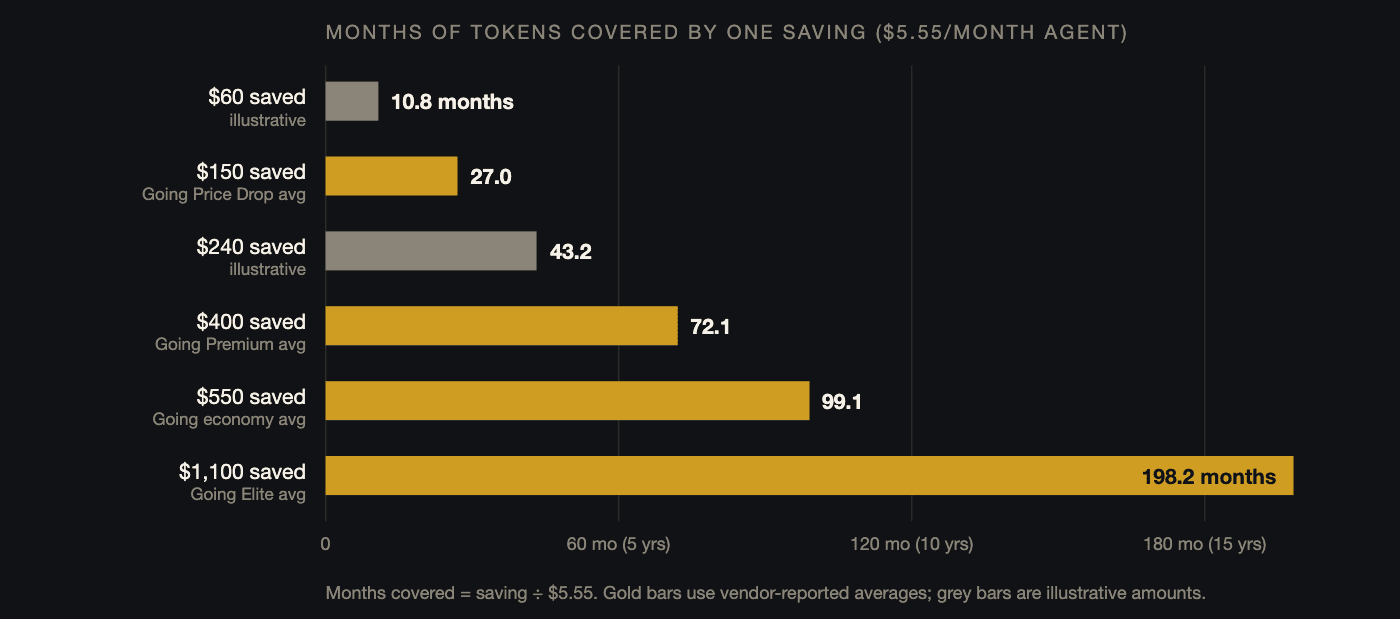
Airfare is the cleanest case: the price moves constantly and the saving is a number on a ticket. Going (formerly Scott's Cheap Flights) reports, as vendor-reported figures, a 44% average saving per roundtrip ticket, $1,100 average per roundtrip for Elite members booking business or first, $400 for Premium, and $350 even on the free tier. Its current site copy, also vendor-reported, says most members save an average of $550 on economy flights.
Going Price Drop (beta from May 2026, launched in September) is closer to an always-on agent: it tracks fares after you book and alerts you at a 10% fall. Forbes reported on 23 September 2026 that travellers who found a lower fare saved an average of about $150 per ticket, again on Going's own vendor-reported numbers. Hopper claims 95% accuracy for its price predictions, a press-reported vendor claim with no independent verification.
Do the division. Against a $5.55 agent, a $150 catch covers 27.0 months of tokens, a $550 catch 99.1 months, and one $1,100 catch 198.2 months. That is the flip from demo to product: one good catch pays for years of running.
The enterprise proof is xAI's Haggle Bot, from a vendor case study dated 4 September 2026: an always-on procurement agent negotiating renewals and licence seats. xAI reports that in its first week it saved over $100,000, reclaimed 43 inactive seats worth $14,220, eliminated $85,662 of unused SKUs, and cut one office order from $14,629 to $6,143, a 58% reduction. The architecture matters: a standing job, tiered permissions, and a human who approves the final call.
Why receipts, specifically
Why receipts, and not features or delight? Because of renewal.
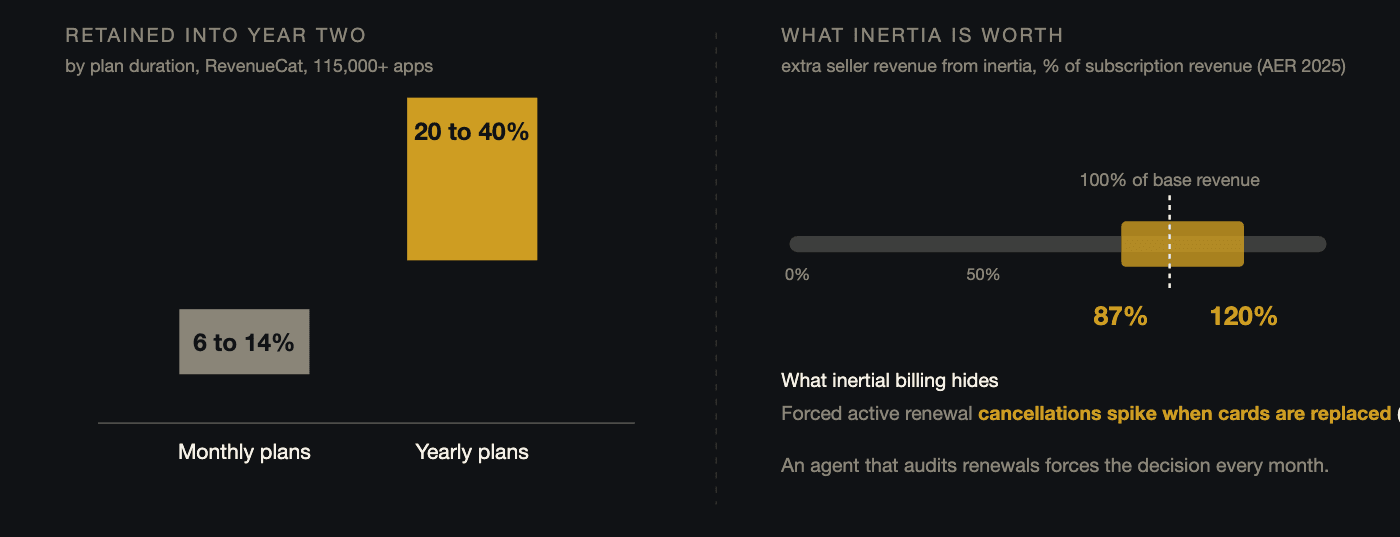
RevenueCat's 2026 analysis of more than 115,000 subscription apps and more than $16 billion of revenue found that retention is lower for AI apps at every plan duration, and that AI apps refund 20% more often than the rest (a 4.2% median against 3.5%). Plan length does more work than category: yearly plans hold a median 20 to 40% of subscribers into the second year, against 6 to 14% for monthly plans. Novelty gets the first payment. It does not get the second year.
Then look at what quietly props up subscription revenue. Einav, Klopack and Mahoney, in the American Economic Review in 2025, used data from a large payment card network and found that the months when a card has to be replaced, and an active renewal decision is therefore forced, are the months with much higher rates of cancellation. Modeling that friction two ways, inattention and switching cost, they estimate consumer inertia raises seller revenue by 87 to 120% on average, roughly double what the same subscribers would otherwise be worth.
Agents end that. Axios reported on 17 October 2026 that AI agents threaten subscriptions by making cancellations easier. An agent auditing my spending makes every renewal cheap to revisit, which turns the inertia premium into a forced active decision, month after month. Recurring billing becomes recurring justification. The only product that survives that audit is the one that can point to what it returned.
The trust ceiling
There is a catch. People want the work done. They do not want the money spent without them.
The survey numbers draw a clear ladder. Mastercard predicted on 8 September 2026 that one in ten people will routinely use AI agents to shop and pay by 2030. A Radial survey found 58% of consumers say they are open to placing orders through an AI assistant, but only 6% have actually done it. Among US consumers, 72% use AI to shop, but only 23% trust it to complete a payment.
Accenture's 2026 Consumer Pulse delegation dial shows the slope cleanly: 74% are comfortable with an agent that follows rules, 32% when it chooses within a budget, 12% when it completes a payment, and 9% with full autonomy. The steepest drop comes the moment the agent is allowed to choose with money.
Those who cross over pay. Menlo Ventures' State of Consumer AI 2026 found four in ten AI users have tried an agent, and 92% of consumers who use agents pay for AI, against 55% of AI users overall. Among payers, 21% of regular agent users pay $100+ a month against 5% of non-agent payers.
So the answer is not more autonomy. It is the tiered permission design xAI describes for Haggle Bot: the agent reads and recommends freely, acts within a narrow budget, and brings the final call to a human. That is the money gate from Figure 2, written as policy.
What breaks it
I believe the argument above, but it is not safe. Four things could break it.
- Token prices can rise. The whole receipt test rests on a $5.55 baseline. DeepSeek has already raised V4 prices as demand strained capacity, with output up as much as roughly 371% on some tiers. Routing only helps while a cheap tier exists.
- The MCP estate is insecure. The Cloud Security Alliance reports that Censys found more than 12,500 internet-accessible MCP services in an April 2026 scan, and that the ones examined in detail accepted connections with no authentication at all. An always-on agent with tool access is an always-on attack surface.
- GUI agents are brittle where no API exists. Plenty of the services I want audited have no API. An agent that drives a web page breaks when the button moves. Headless only helps where the vendor has actually gone headless.
- An agent only audits what leaves traces. I picked this one up from the discussion around the Abundance Economics briefing note in August 2026, not from a study. An agent that judges value by visible activity will under-value dormant services (insurance, backups), and services will adapt by manufacturing legibility for the audit. Receipts can be faked like anything else.
The household version
Back to the shelf in Karachi. One Mac mini, a handful of cron jobs, and a token bill that, routed sensibly, sits in single dollars a month. What does it return? Some mornings, nothing. Some mornings, an advisory I would have missed or a price I would have paid. I do not need many of those to cover the year.
There is one metric worth keeping: dollars returned per dollar of tokens. Not tasks completed, not hours of runtime. Measured retention will follow measured savings.
Here is the checklist I apply to my own agents.
- Can it show me a receipt: a specific amount of money or time it found, with the evidence attached?
- Do I know its cost per run and per month, at off-peak and peak pricing?
- Is the high-frequency loop on a cheap tier, with only the hard cases escalating?
- Does it stop at a human before any spend, signature or irreversible action?
- Are its tools authenticated?
- Would its value hold if token prices doubled?
- Is it measuring real savings, or just generating activity that looks like value?
If it cannot show you a receipt, it is a toy.
Sources
- Salesforce newsroom, Headless 360 launch, 15 April 2026, and the August 2026 expansion: https://www.salesforce.com/news/
- Reuters, Marc Benioff on the end of the SaaS era as we know it: https://www.reuters.com/
- InfoWorld, On platforms that require humans to click through UIs: https://www.infoworld.com/
- Model Context Protocol, Official server registry: https://registry.modelcontextprotocol.io/
- Cloud Security Alliance, Research note on MCP security, with the Censys scan figures: https://labs.cloudsecurityalliance.org/research/csa-research-note-mcp-security-crisis-20260504-csa-styled/
- NVIDIA, Personal AI Router (PAIR) product page: https://www.nvidia.com/en-us/ai-on-rtx/personal-ai-router/
- NVIDIA developer blog, PAIR, and the five-subagent demo that fell from 18 minutes to 8m48s: https://developer.nvidia.com/blog/nvidia-pair-virtual-inference-router-expands-available-compute-on-your-local-network/
- NVIDIA, Local AI at IFA 2026, including PAIR support in Hermes Agent: https://blogs.nvidia.com/blog/local-ai-ifa-next-gen-agents-nv-pair-rtx-spark/
- Microsoft, Build 2026, Scout and the Aion 1.0 on-device models: https://news.microsoft.com/
- Nous Research, Hermes Desktop: https://nousresearch.com/
- Stanford Hazy Research, May 2026 retrospective, hybrid by design, local by default: https://hazyresearch.stanford.edu/blog
- arXiv, Personal AI, On Personal Devices, 2605.17172: https://arxiv.org/abs/2605.17172
- DeepSeek, API pricing, including off-peak rates: https://api-docs.deepseek.com/quick_start/pricing
- RevenueCat, State of Subscription Apps 2026, 115,000+ apps and $16bn of revenue: https://www.revenuecat.com/state-of-subscription-apps-2026/
- Einav, Klopack and Mahoney, Selling Subscriptions, American Economic Review 115(5), 2025: https://web.stanford.edu/~leinav/pubs/AER2025.pdf
- Axios, On AI agents making subscription cancellations easier, 17 October 2026: https://www.axios.com/
- Going, Newsroom savings figures, and Forbes on the Price Drop tool, 23 September 2026: https://www.going.com/newsroom
- xAI, Internal procurement agent case study, 4 September 2026, vendor reported: https://x.ai/
- Mastercard, Agentic payments forecast, 8 September 2026: https://www.mastercard.com/
- Accenture, Consumer Pulse 2026, the delegation dial figures: https://www.accenture.com/
- Menlo Ventures, State of Consumer AI 2026, agent adoption and spend: https://menlovc.com/
- IDC and Canalys, AI PC shipment shares for 2026: https://www.idc.com/